Showing posts with label 17th Century. Show all posts

Tuesday, April 22, 2014

Biddle?

Leave it to the 17th century to vernacularize (new word?) thatching tools. During my research of what we needed to thatch one of the houses in the village I first found that a biddle was a thatching ladder that hooks into the roof. This was all well and good...that was until I found that certain groups of people also called the paddle used for beating the thatch a biddle. Most of you will know this tool as a Legget, if you know it at all. Further still I have seen one source referring to this paddle as a Dutchman, referring to the Netherlandic (another new word?) pattern used.

This is half the problem doing research on work-ways in the period. Everyone calls similar items by different names, and even worse, different items by similar names. If that isn't enough, even when you know the name for something you might not spell it the same as they did back in the day.

For instance, I have seen these thatching paddles called: paddles, battles, liggets, dressers, baddles, biddles, leggets, beetles, bats, and...yes...even Dutchman. On a side note, beetles are also large wooden mallets used for splitting pale and persuading timbers, leading to an even more convoluted set of tool terms.

This is all academic minutiae of coarse and the only thing that matters is that leggets are very real things, even if they do exist in two places at one time. On to the build!

To start off, I found a white oak crook with just the right proportions and angles. Five minutes at the shaving mare and I had a very respectable looking handle. I also took a nice clear pine log (possibly Eastern White, but I can't be sure) and split it up to make a rough bolt. Five more minutes with a hatchet and I had a reasonably flat and square hewn board. Good enough for me!

The blank pieces before any joinery. Saw, hatchet, and draw knife.

The geometry of a legget is pretty simple, step off the board into equal segments, scribe parallel lines, and then mark the end grain with 45 degree angles. Next it was as simple as letting in the lines with a rip saw and paring the waste using a sharp chisel. I used a flat sided firmer chisel just to see if I could use the tools a farmer-carpenter might have available, but a bevel edged paring chisel would have made the whole thing a breeze.

Half way done, using my new carpenters bench...but that is a different story

After establishing the ribs on the front, I flipped the board over and scribed the handle onto the back to make a socket. This is real rough work...but also real precise work. It needs to fit as snug as possible so it stays tight after lots of abuse, but it is a tricky irregular notch, so there is room for some wiggle, I just used my judgement and a small 3/4" chisel.

The X was scribed on the back to find the center. The handle was placed by eye.

Finally was clenching the paddle onto the handle. I have the distinct advantage of working with two great blacksmiths, so I had hand made wrought iron nails to use. If you wanted to do something like this, or have another project in mind, the museum's blacksmith Mattheo does some great commission work, so check out his shop!

The handle and paddle joined.

I used four long nails that I clenched in alternating directions which will hopefully lend strength to the connection. The fifth nail was driven at a slight angle into the handle. Don't ask me why I did this...it just seemed like a good idea at the time.

Some selective carving was done to allow for flat faces for the nail heads.

We only have two sizes of wimble and bits at the museum, nail and spike. Turns out the nail bit is slightly larger than the nails, as it should be when installing pale and clapboards, but it was a little looser than I would have liked on this project. Luckily I alternated the holes, and these wrought iron nails are great for clenching, so I feel like I got a nice strong connection.

This tool has a simplistic beauty that is unmistakable.

By May this legget should have one thatched roof and several cap repairs under its belt, so I will have to give a status report then. Overall I am really happy with the result, it feels super stable, has a great sweep to the handle, and is probably the most work-manly thing I have made to date. Total build time was about 4 hours from log to legget.

Did the settlers care about ergonomics, because this legget has it in spades!

Wednesday, April 9, 2014

Biddle

We are ramping up to thatch the new frame in the village, and to prepare I have been diligently researching the period tools necessary for traditional thatching. We will be thatching in the public eye, so authenticity is an absolute must. So first on the docket is the precursor (at least in my humble opinion) to the modern hook ladder used for slate roofing, the biddle.

Basically, a biddle is a short ladder with some iron hooks that pierce through the thatch and hook onto the lath on the roof. This gives a nice versatile working platform that you can move around at your leisure. I started with a bow of Sassafrass and hewed it on four sides. Working such a small piece of wood was a nice change of pace. I didn't even score to my line, just started hewing with a hatchet, and within the hour I had a relatively squarish timber.

I love the sweet smell of Sassafras while it is being worked

Next, I bored holes through the piece. I think I did every 12", but it is more important to be consistent than to hit an exact number. These holes will accommodate the rungs of the biddle, and are about 7/8" diameter. It is best to auger the holes before ripping the stiles apart, that way you don't have to bother with that shop math that always seems to go wrong to line up all the holes.

Two squares keep me boring plumb

Before the comments start flowing in, I know a screw auger is not 17th century accurate, but unlike the Brewster Chair, no one will know I used it because these are through holes. Sometimes efficiency trumps authenticity, especially when no one is the wiser (I think I just blew my cover).

Next was ripping the small timber into stiles. Luckily I learned the Tao of Saw Sharpening from the always helpful Saw Wright, Matt Cianci, so I had a newly sharpened rip saw waiting in the wings.

Using a wedge keeps the piece from pinching

This biddle will be used on roofs up to 30 ft in the air, so I wanted it to be as robust as possible. This lead me to put mortised rails on the top and bottom to hold the whole thing together. I chiseled the mortises with a 3/4" chisel, and cut the tenons to fit.

It is easier to fit the tenon to the chisel, than fit the chisel to the tenon

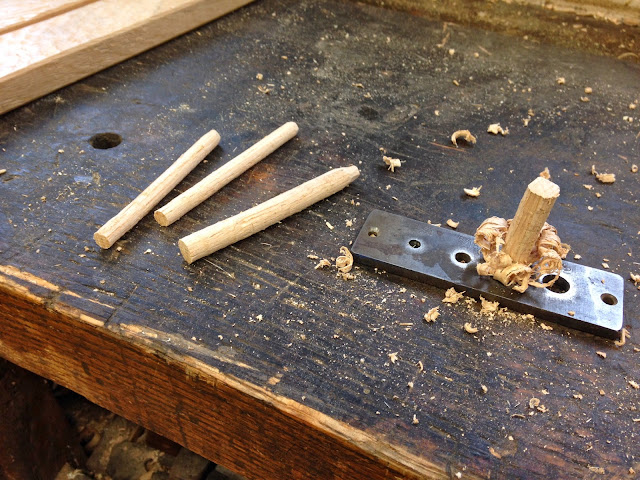
Keeping with the "I don't want to fall off the roof and die" mentality I also draw bored the mortise and tenons for a nice tight assembly. For the pegs I used bone dry riven white oak and noisily banged it through a dowel plate.

Dog holes in the bench are perfect places for the pins to be blasted through the plate

Remember my note on screw augers above? Yeah...refer to that in regards to dowel plates.

In addition to the draw bores, I also made all of the rungs with stopped shoulders and tiny little wedges to secure them into the stiles. Note to self, there is a reason they didn't wedge ladder rungs...it makes construction about twice as long. Now all I needed was a mallet and earplugs to knock this bad boy together.

Tap, Tap, Tap

I got a little carried away knocking the whole assembly together and it fell right off the bench, but it didn't self destruct, so that is reason to be happy.

It is easy to get giddy when approaching the end of a new, exciting project

The last piece to be dealt with was making the tiniest stupidest through tenons I will probably cut in my life. These were for the iron hooks that our blacksmith made for me. The mortises were 3/16" x 3/4" and went through the whole 3-1/2" piece of Sassafrass, and they had a stepped shoulder to boot.

A tight fit now ensures a tight fit later

Clenching the biddle hooks is pretty much the same as clenching nails...except you use a sledge hammer and swing as hard as you can.

There is a fine line between clenching and splitting with these bad Larrys

Finally, I step back and admire my hard work, not bad if I do say so myself. Total hand tool construction, all the way from felling the tree with an axe. Next on the list of thatching tools is a biddle (that is not a typo...but it IS a story for another time).

I need to get The Boss to take better pictures for me...


Wednesday, March 26, 2014

17th Century Hatchets

Being that at least half of my carpentry work is done in front of the public in a 17th century context, it is essential that my tools are as historically accurate as possible. The big problem with this ideology is that historical tools from this era are a little bit hard (aka damn near impossible) to come by, and when we do find them, we try to preserve and study them rather than smash them against pieces of wood.

As a work around, the blacksmiths at the museum reprofile modern axes to better impersonate these actual historical artifacts. My new hatchet started its life as a Wetterlings broad axe (that's right, us badass pilgrims use broad axes as hatchets, but I digress).

Stock Wetterlings Short Handled Broad Axe #190

The pattern that my new hatchet is based on is from Martin's Hundred and dated to around 1621. It was found in the ground along with various other tools, most likely buried there to prevent the native populations from repurposing the metal into tools and weapons.

Archeologist's sketches of a Martin's Hundred hatchet

The Wetterlings head is hack sawn away to the same profile as the Martin's hatchet, removing a lot of the weight from behind the eye and reducing the bit length by several inches.

The hacked up head...luckily this was not my job

Next I reground the bit into a nice fair curve, filed it for a convex bevel, sharpened it with whetstones, and stroped with a piece of leather charged with rouge polish. Finally I helved the hatchet with a white oak handle (remember these are English settlers in 1627, they probably don't know the wonderful qualities of Hickory as handle stock).

The finished hatchet. I like a nice healthy fauns foot for power! 

Overall this is a beefy hatchet with one hell of a bite. You can see how thin the historic hatchet is right in front of the eye, but the Wetterlings is quite thick, giving it much more mass. After four hours of trimming lath, I appropriately nicknamed this hatchet "Wrist Breaker."

Check out all that iron in front of the eye.

In order to protect the edge, and lessen the amount of sharpening I need to do, I made a nice wooden blade guard (note that this is not historically based on anything).

An ash blade guard with some hemp rope to hold it on.


Sunday, March 2, 2014

Failure is not...not an Option

Those of you that have been following my blog for a while have noticed that I have had several cliff hangers that have not been addressed. I would like to blame these loose ends on relocating for my new job...but mostly it is because I am a lazy blogger. So here is my small peace offering for those that have been waiting anxiously (but not really) to find out how my basket weaving attempt ended.

Although I started well enough, things soon turned south as I went to start the sides of the basket. Before this debacle, however, I first collected some cherry shoots from my pseudo-coppice in the Alden House garden.

Two cherry faggots for the sides

The next order of business was to do some research. I found a couple of helpful articles and videos online that are worth taking a look at, even just for pure unadulterated curiosity. After picking up what I thought would be helpful tips I got back to work. I sharpened the spars, so they jam into the weavers better, and inserted 12 of them into my basket bottom.

Sharpened spars

In case you aren't familiar (like me) with basket weaving, 12 is a very poor number for spars. In order for the weavers to alternate over-under-over-under continually as you spiral around the basket you need an odd amount of spars...and through four years of mathematics and engineering I am almost positive 12 is not an odd number. Unfortunately I did not know this fact when I started this basket.

Once the spars are in, it was time to bend them to set the hard corner between the base and sides of the basket. I tried several methods to achieve this bend, and none of them worked very well. Boiling made the cherry brittle, bending without modification just fractured the stock, twisting while bending only rent the fibers asunder, so I found the best (out of the horrible solutions) was to cut a small notch through half the thickness of the shoots which helped reduce fracture. This is probably a good reason why you don't see a lot of cherry baskets.

Spars inserted and bent up the sides

Finally I started winding the weavers over-under-over-under-over-over; yup that even number of spars bit me in the ass.

Oh, and another good tip that I found AFTER botching this basket, is that you can reverse the direction of weaving when you start the sides, this reversal makes the basket stronger (don't ask me why).

As can be seen...the sides didn't shape up very well

After a couple hours of trying to weave the sides, unwind them, and try again, I finally surrendered and admitted to myself that this basket was not meant to be. Since this attempt I have done even more research, including videos, books, and blogs, and I have been looking into some basket weaving courses locally. Hopefully my next attempt will be a little more inspiring, but this is The Clueless Woodwright, not 'The Has Everything Figured Out Woodwright' (that just doesn't have the same ring).

Monday, February 3, 2014

The Dregs of Society

A lot of change is happening at work recently and as a result we are cleaning out spaces and finding fun toys...I mean tools...to play...I mean work...with. On top of that, our tractor is currently out of service, but work must go on. Luckily we found (what we thought was) a Dreg in one of the storage sheds.

A modern Dreg with spindly wheels.

Flash forward a week and we needed to move a log from the hewing bocking to the saw pit. The log was a wet piece of white oak 10"x10" 13 feet long, so it was waaaaay heavier than four men wanted to lift, what a great time to try out our new set of wheels.

Rope makes pulling and steering a lot easier.

What an easy job it was! If it wasn't for pulling the log up an icy hill we could have easily handled this thing with two men. Looks like a 17th century Dreg just topped the project list. It will make timber handling a fantastic exhibit rather than a dirty little secret we do before visitors arrive.

I get the easy job of taking pictures.

Wednesday, November 6, 2013

Nature Does it Best

I could have found definitive proof from a 1620s English woodcut of a pitchfork.

I could have designed small yet strong joints that could withstand years of bad weather.

I could have spent the afternoon dressing my stock and fussing to make sure everything fit tight.

Or...I could let nature do its thing, and take care of all the tough stuff for me.


Thursday, October 31, 2013

Branching Out

Being surrounded by the 17th century and it's crafts and wares on a daily basis tends to seep into your psyche. As a result I have had a nagging obsession with weaving a basket. So I decided I would try my hand at it and see where it gets me.

Step one was finding material. I first tried Green Briar because it grows like a weed around the museum. This turned out to be a big waste of time. It is kinky (not in a fun way), thorny, and quite brittle when trying to bend it, all very poor qualities when making baskets.

Flash forward a couple days and I was cutting nice Cherry coppice shoots for some wattle in a wall. After trimming off the smaller branches I noticed that they were the perfect size and springiness for basket weaving. I bundled the "scrap" and headed off to the shop after work to do some...work.

One cherry faggot!

Copying some of the period baskets that I studied at the museum, I made two sets of three spars for the bottom of the basket. And by studying I mean looking at briefly and observing all the nonessential details and ignoring the actually important construction techniques...I might have to take a better look at some of the baskets in the future.

Six spars makes twelve spokes...now I think I am just making up basket terms.

Next I starting weaving, over and under over and under over and under...you get the point. This is where better observation would have helped me out...I was pretty much just making things up as I went along.


Here is the bottom coming along nicely.

After about 45 minutes I had an almost finished bottom. I tried to add the spars for the sides, but I didn't have stock that was large enough, and I need to research how I can go about bending the sticks at right angles without snapping the wood (maybe boiling first?).

Some spindly looking side spars.

Off to the coppice grove (aka Alden House garden) to harvest some more stock before continuing this basket, stay tuned for part two shortly.

Monday, October 28, 2013

My Mallet is Still Cooler than Yours

Still fightin' words, but once again I am confident that this statement is true...plus I now have two cool mallets that could absolutely beat up yours in a fight. On top of other ridiculous goings on at the museum, I am able to make my own tools in traditional manners. As I was making some gluts out of really nice straight grained hickory I noticed that this was some really choice wood...and I could really use a carpenters mallet.

I did some quick research and found some great wood cuts and engravings, as well as Moxon's description of a carpenters mallet. So based on these overall proportions and shapes I made myself as traditional a mallet as I could (of course beech would have been the ideal choice of wood). I limited myself to only hand tools, and even used a wooden plane to smooth the faces and fair the top curve (a lot tricker than metal planes, but really satisfying). The mortise is not as tapered as I would have liked, so I added a couple pegs to keep things nice and snug.

Heart wood and sap wood are just as useful in Hickory.


Monday, September 9, 2013

The Schwarz-Follansbee Complex

A few months back Chris Schwarz posted a string of blogs (here, here, and here) about "Roman Style" workbenches. I initially passed them off as a novel form of workbench, and figured it would be interesting to see what he did with his ideas of reviving these early workbench vernacular forms (that's right, I bought a thesaurus).

Pompeii Workbench, circa 50AD

Flash forward to last week and Peter Follansbee tells me that he is making some benches out of the oak flitches we had left over from some band sawing we had done for the "Big Fence" Project. I again thought nothing of what Peter had said...that was until I saw what the benches looked like.

A very familiar looking form

Instantly I thought back to the spindly legged workbenches that Chris had written about with slab tops and holes for holdfasts and planing stops. The two forms, deriving from two seemingly opposite origins, shared a shockingly similar appearance, in fact, they were so similar that I almost grabbed a brace and bit, bored a couple of holes in Peters bench, and took it for a test spin.

Needless to say I did not actually go through with this plan, for starters Peter would not be too happy to have me putting holes in his benches, and secondly I need to do some hardcore research into 17th century work holding and whether or not the "Roman" form was still in use by agricultural societies...like English planters in New England...say around 1627. Off to the archives!

Research will probably look something like this...

PS. I am pretty sure Chris and Peter are in cahoots. Kind of the ebb and flow of the hand tool world. They pretend as though they butt heads, but really they are masterminding the greatest renaissance since....well the renaissance. St. Roy probably has something to do with this as well.

Thursday, September 5, 2013

I won't tell if you won't tell

So the other week at the museum we cheated a little bit on our material preparation. We have a prolific palisade project (alliteration not intended...but intended) over the summer with a very definite deadline and as a result we have been hewing posts and splitting pale like madmen. Our total goal is 27 hand hewn posts, 33 sawn rails, and about 400 pieces of pale. On top of these staggering numbers we are also one carpenter down (no worries, no one was hurt) so the rest of us are picking up the slack.

This is our running tally of logs hewn and logs split...we are getting there! 
 
As a result of this massive material manufacturing marathon (see what I did there) we have little time to learn pit sawing and even less time to actually pit saw all of the rails that we will need for the project. Enter the band saw mill! It does pain my heart a little bit to see band sawn rails going into the project after so much sweat has been put into traditional techniques, but sometimes economy outweighs authenticity. Luckily the band saw mill was one of the coolest pieces of machinery that I have ever seen (GASP! That isn't very woodwright sounding).

Nothing miserly about this rig, Bob the owner really knows what he is doing.
 
This bad boy could take logs over 24" in diameter and spit out slabs of any size. It lifts the logs into place, rotates them into the correct orientation, adjusts the table to compensate for tapering at the bell, and clamps the piece firmly for sawing...hell I am sure it probably makes your lunch if you have the right attachment.

Some finished rails...so maybe it is a little easier than pit sawing

We were aiming for 3-1/2" x 5-1/2" for our rails, so we had to start with some pretty massive slabs around 15"x6" (eat your heart out Mr. Schwarz and Monsieur Roubo).
 
If only we could have stopped here...and opened a workbench building business.
 
Some of the white oak we were sawing was absolutely gorgeous, and we joked that it was a crime that we were sawing it up just to rot away on a fence that would be keeping away imaginary Narragansett's.
 
Absolute gorgeous grain.

The best part of the whole day, was that the "waste" from the band sawing were some pretty decent slabs of white oak, some of which were upwards of 4" x 10" in cross section.

The slab laying aside is the "Scrap"

So as any self respecting hand tool enthusiast would do, I grabbed a chainsaw and some Elmer's glue and stickered up this "scrap" to set aside and dry...for the next three years...in hopes that I can build a bench...as long as it doesn't check...or warp...or...well you get my point.

All stickered up...I should probably go do something while this dries

Along with the slabs of oak we had a whole bunch of really big 12 foot long flitches from the outsides of the logs...but that is a story for a different time!

Monday, August 26, 2013

Rumors of my Demise Have been Greatly Exaggerated!

It has been a while since my last post, so I figured I would share an update and some pictures to show what I have been working on. Since starting my new job, I have been expanding my hand woodworking skills at an alarming rate. Helving axes, making mallets, fixing beetles, splitting pale, hewing logs, and a whole other slew of incredibly useful skills (relative term according to The Boss) for a self proclaimed woodwright!

I wont go over everything that I have been up to in this post...that would ruin all of my great material, plus I think the long-windedness (awesome new word) of a post like that would scare away any potential readers. I will however share the first completed project that I did as a 17th century carpenter.

We were making a new goat pasture so naturally we needed a garden gate to get in and out of the pen. I started with a huge oak log and split, rived, trimmed, and smoothed my way to reasonably flat and straight lumber. Green woodworking really is a beast of a different color, and it is great fun trying out new skills that have been essentially extinct for at least a hundred years or so. The gate was assembled using hand wrought nails and a method called clenching...which is basically a way to bend nails on purpose. Another important note is that everything is done using traditional 17th century vernacular, so before making this gate I went and did some research into paintings, engravings, woodcuts, and written documentation on the appearance and construction of garden gates (it seems a little bit overkill when I write it out).

A garden gate with riven oak and clenched nails. That should keep the goats at bay!

Another adventure I had very quickly at my new position was going to see Mr. Schwarz himself give a talk on the history of tool chests. We hosted the Early American Industries Association for a day, and in return we were able to attend their conference down in Hyannis.  Most of the material was taken from The Anarchist Tool Chest, so I was familiar with it, but there was some additional pictures and information not included in the book, most notably some stunning sneak peak photos of the H.O. Studly tool chest (Google it if you have never seen it...you're welcome).

Chris Schwarz in the flesh ladies and gentlemen. 

I have a ridiculous amount of photos and stories that I have been accumulating in the last three months, so check back often as I am planning on clearing up my backlog and returning to boring you all to death with erroneous details.